New member: Xiaoming Hou

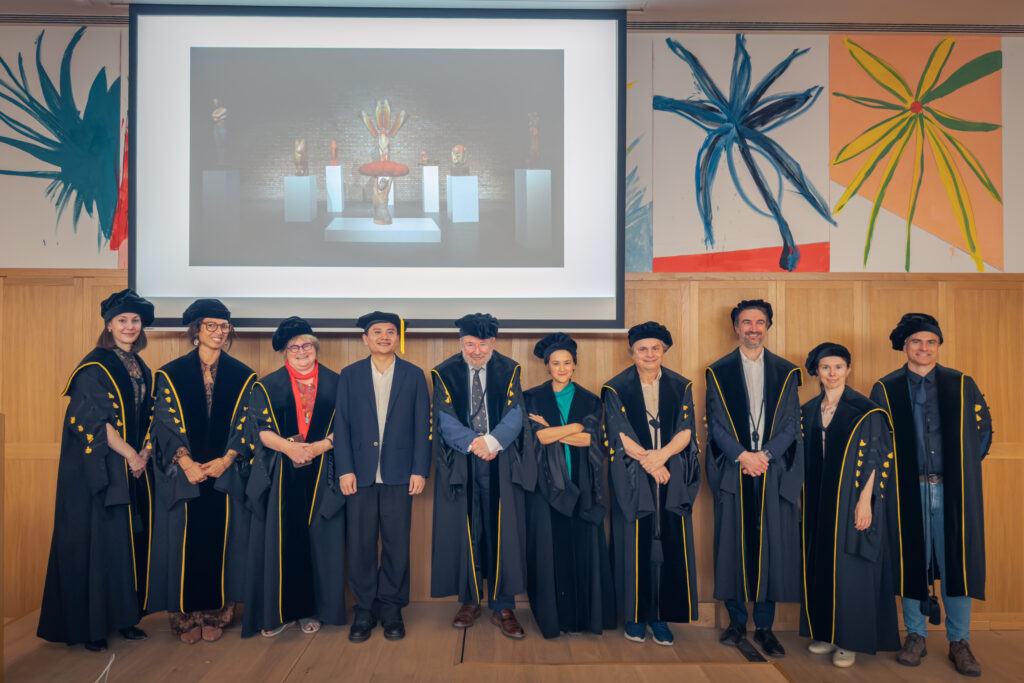
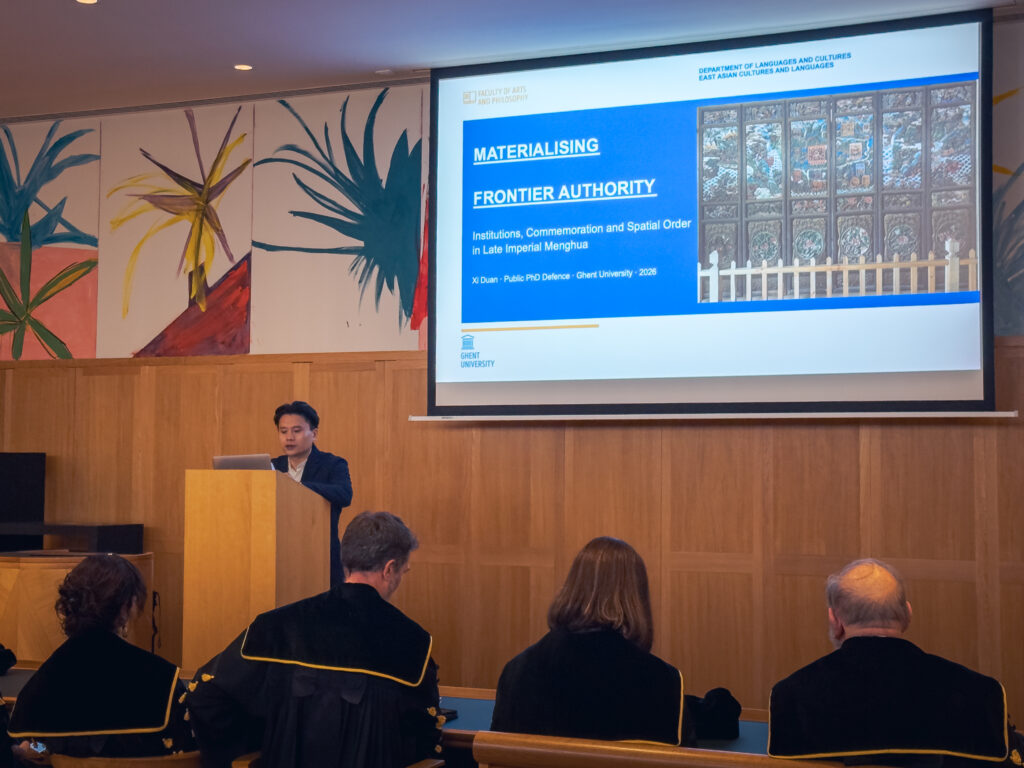
We are welcoming a new member of the Ghent Centre for Buddhist Studies: FWO junior postdoctoral fellow Dr. Xiaoming Hou. Her research focuses on scholastic practices in medieval Chinese Buddhism and the cross-cultural transmission of Buddhism, with particular interest in exegetical traditions. Her current FWO-funded project, Visualizing Doctrine: A Study of Exegetical Diagrams in Medieval Chinese Buddhism (8th–10th Centuries), examines exegetical diagrams (fenmen tu 分門圖 and kewen 科文) from Dunhuang and their role in the transmission of scholastic knowledge. It investigates how diagrammatic and material practices shaped scholastic reasoning and pedagogical methods in local Buddhist communities, reframing these diagrams as epistemological tools situated between text and image.

She received her Ph.D. in 2022 from EPHE/PSL (École Pratique des Hautes Études/Université Paris Sciences et Lettres) in Paris, Department of Religions and Systems of Thought. Her doctoral thesis, Pratiquer le bouddhisme en chinois: traduction et reconstruction des enseignements sur la méditation bouddhique du IIe au VIe siècles en Chine, explores the interdependent dynamics between meditation and exegesis in early medieval China.

Fieldwork of GCBS researcher Mariia Lepneva in Vietnam, December 1-6, 2025

GCBS member and FWO postdoctoral fellow Mariia Lepneva recently completed a one-week research visit to Vietnam. Below is her brief report.

My research visit to Vietnam began with consulting primary sources at the Institute of Hán-Nôm Studies in Hanoi. I identified a work by an abbot of Baohua Mountain—the site I am studying in my ongoing FWO postdoctoral project on its transformation into a new center of the Vinaya tradition in China—that was long considered lost in China but has been preserved in Vietnam. I also discovered early editions of two additional Vinaya texts, as well as another Vinaya commentary written in Nanjing in the seventeenth century.

Entrance of the Institute of Hán-Nôm Studies
Library of the Institute of Hán-Nôm Studies


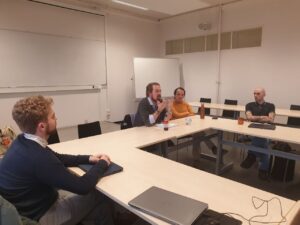
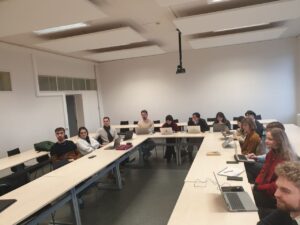
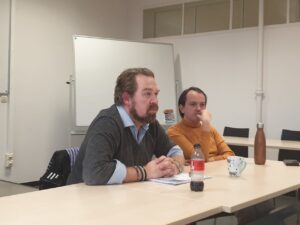
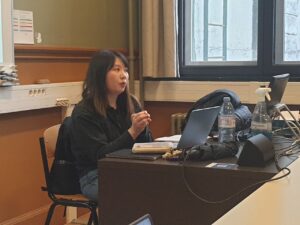
On December 4, I delivered a talk at the Trần Nhân Tông Institute—a research institute dedicated to Chán studies under the umbrella of Vietnam National University. In her lecture, she introduced the activities of the Ghent Centre for Buddhist Studies, presented an overview of her research project, and highlighted the crucial role of Vietnam in the regional circulation and preservation of Buddhist texts.

Talk at the Trần Nhân Tông Institute

On December 5, I visited two monasteries in Hanoi. Chùa Quán Sứ (舘使寺) is famous for its repository of Buddhist text, and Chùa Bà Đá ̣̣(formerly known as Linh Quang tự 靈光寺), where a number of Buddhist texts that I am interested in was printed in the nineteenth century.  My last day in Vietnam, December 6, was dedicated to fieldwork in Hải Phòng, a major port city in the northern part of the country, kindly arranged by my host Dr. Nguyễn Tô Lan (), Institute of Philosophy, Vietnam Academy of Social Sciences. In the morning, we visited Phúc Lâm Tự (福林寺), a monastery that preserves a remarkable set of sutra woodblocks. We also stopped by the Haiphong City Museum as well as two nearby communal houses, which served roles similar to city god temples (城隍庙) and functioned as local council halls where community affairs were traditionally decided. In the afternoon, we traveled to one more Buddhist monastery Khánh Vân Tự (慶雲寺)—better known as Chùa Quảng Luận—where we had a meaningful and engaging conversation with Venerable Thích Quảng Nghĩa.

Observing a prayer in the monastery Chùa Quán Sứ, Hanoi.
Sutra woodblocks at Phúc Lâm Tự, Haiphong
Buddha statue at the monastery Chùa Quảng Luận, Haiphong
Discussion with Venerable Thích Quảng Nghĩa at the monastery Chùa Quảng Luận, Haiphong

Reading group meeting, presentation by Wushi Lin, October 23, 2025

The next phase of the Reading Group convened on October 23, 2025, marking the first of three sessions dedicated to the study of materials prepared by Wushi Lin, a joint PhD student of Professor Bart Dessein (Ghent Centre for Buddhist Studies) and Professor Weijen Teng (Department of Buddhist Studies, Dharma Drum Institute of Liberal Arts). The materials focus on the epistemological interpretation of the no-self doctrine by the influential late Ming dynasty Buddhist monk Zibo Zhenke (紫柏真可, 1543–1603), and are part of Wushi Lin’s PhD project, “Comprehending Everything as Oneself: The No-Self Doctrine of Zibo Zhenke in Ming Dynasty Buddhism.”

New member: Dr. Kikee Doma Bhutia

Please join us in welcoming Dr. Kikee Doma Bhutia, who, having won the FWO Junior Postdoctoral Fellowship, will be with the Ghent Centre for Buddhist Studies for the next three years. Her project, “Local Deities, Natural Disaster, and Ritual Waste in Vernacular Buddhist Practices in the Himalayas,” project examines the intersection of local religious practices, environmental policies, and waste management in Sikkim, with a particular emphasis on the influence of Buddhist rituals and beliefs on the community’s approach to sustainability.

Despite its relatively small geographic size, Sikkim has emerged as a leader in environmental initiatives, including the prohibition of plastic and the promotion of eco-friendly practices. However, traditional rituals, such as the tying of prayer flags and the use of synthetic materials in religious offerings, pose significant challenges to environmental conservation. This research investigates the roles of local deities, vernacular Buddhist practices, and monastic institutions in waste management, analyzing how religious concepts are integrated into environmental policies. Utilizing ethnographic fieldwork, interviews, and archival research, this study will explore how communities navigate the complexities of modernization and tradition, thereby contributing to academic discussions on waste, religion, and sustainability in the Himalayas. The project aims to produce scholarly articles, presentations, and public outreach materials, thereby fostering both academic and social engagement.

New member: Yurui Zhao


Yurui Zhao is a joint PhD candidate at the Department of Languages and Cultures, Ghent University, and the School of Chinese Classics, Renmin University of China. Her research focuses on the social, religious, and cultural history of China during the 4th–6th centuries. Her doctoral dissertation, Taoism and Social Life in Southern China during the Jin, Song, Qi, and Liang Dynasties, adopts a cultural-historical approach to examine the interaction between Taoist beliefs and social practices in Southern China during the Wei, Jin, and Northern and Southern Dynasties.

Her project aims to reconsider the realities of Chinese society in this period by tracing the development of Taoism. Her study will extensively use Taoist literature, connecting it to social life to provide insights into the relationship between Taoist rules and social behaviors. Additionally, it will analyze historical records, anecdotal literature, and literary works to explore people’s views on social, moral, and ritual behaviors. Finally, it will utilize archaeological materials, like tomb epitaphs and murals, to reveal how Taoist beliefs influenced daily life and social values.


Doctoral school “Current Developments in Research on Middle Chinese and ‘Buddhist Hybrid Chinese’””, October 27–31, 2025

This five-day, on-campus course explores how Chinese evolved in the medieval period, its interaction with Sanskrit in Buddhist translations, and the role of Buddhist Hybrid Chinese in shaping medieval texts. In addition, text corpora and digital resources for the study of pre-modern Chinese will be discussed. The course assumes a background in Classical and Modern Chinese, as well as a strong interest in Chinese Historical Linguistics. Lectures will be primarily conducted in Chinese, with supporting readings and materials in English. Students are welcome to present in either English or Chinese.

Date: October 27–31, 2025

Venue: Ghent University

Organizing committee: Prof. Dr. Christoph Anderl and Longyu Zhang

We are pleased to award a tuition fee waiver and scholarships for a maximum of four international PhD students.* To apply, please send a one-page motivation letter and your CV to Christoph.Anderl@ugent.be and Longyu.Zhang@ugent.be by September 28. The selected candidates will be notified by October 1.

* The four scholarships consist of a fee waiver and a travel subsidy:

2 x 800 EUR (long-distance)

2 x 400 EUR (within Europe)

Lecturers:

Prof. Chirui Hu, Peking University

Prof. Chiafei Lin, National Taiwan University

Prof. Christoph Anderl, Ghent University

Doctoral School Programme (version 2025-09-26)

Monday 27th October: Sanskrit and Buddhist Hybrid Chinese: Part 1

10:00-10:15: Welcome (Anderl)

10:15-12:00:梵漢對比研究:理論、方法與實踐[Sanskrit-Chinese Comparative Studies: Theory, Method, and Practice] (Lin)

13:30-14:30: 梵漢對音[Sanskrit-Chinese Transcription] Part 1 (Lin)

14.50-16.00: 梵漢對音[Sanskrit-Chinese Transcription] Part 2 (Lin)


Tuesday 28th October: Buddhist Hybrid Chinese: Part 2 / Students’ Presentations

10:00-11:00: 梵漢對比語法 [Sanskrit-Chinese Contrastive Grammar] Part 1 (Lin)

11:00-12:00: 梵漢對比語法 [Sanskrit-Chinese Contrastive Grammar] Part 2 (Lin)

13:30-16:00:  Students’ Presentations (with discussions; moderators: Anderl / Hu / Lin)


Wednesday 29th October: Buddhist Hybrid Chinese and Non-canonical Dunhuang Manuscripts

10:00-12:00: The Development of Interrogatives in Middle Chinese: An Overview (Anderl)

13:30-15:00: Between Sound and Meaning: Observations concerning 9th/10th Century Semi-colloquial Chinese (Anderl)

15:30-17:00: Students’ Presentations (moderators: Anderl / Hu)


Thursday 30th October: Introduction to Chinese Historical Linguistics / Middle Chinese

10:15-12:00: 中古漢語及其分期 [Periodization of Middle Chinese] (Hu)

13:30-15:00: 两漢漢語概貌 [The Chinese of the Han Dynasty: an Overview] (Hu)

15:30-16:30: 中古漢語的語言環境 [The Linguistic Context of Middle Chinese] (Hu)


Friday 31st October: Primary Sources and Corpora for Research in Pre-Modern Chinese

10:00-12:00: 材料的真實性與口語性 [Discussion on the Authenticity of Primary Sources and their Colloquial Features] (Hu)

13:30-14:30: 兩類事件結構 [Two Types of Event Structure] (Hu)

14:50-16:00: Seminar/discussion: Corpora for Research in Chinese Historical Linguistics (moderators: Anderl / Hu)


Lecturers

Chirui Hu, Professor at the Department of Chinese Language and Literature, Peking University

Chirui Hu 胡敕瑞 is a specialist in Chinese Historical Linguistics with a primary focus on Chinese translated Buddhist texts and excavated texts. His first book A comparative research on the lexicon in Lunheng and Buddhist scriptures from the Eastern Han dynasty (Bashu shushe, 2002) investigates the distinctions of lexicon between classic literature written by native Chinese literati and translated Buddhist literature produced in the Eastern Han dynasty. This monograph provides not only a synchronic description but also reveals diachronic changes through comparison, which filled the gap in research on Middle Chinese lexicon at that time, as compared to phonology and grammar. In addition to his research on lexicon, he has also written extensively about the syntax of Archaic and Middle Chinese and its interaction with lexicon. He has been actively involved in several major research projects. In 2006-2009, he participated in the project “The Evolution of Verbs in Old to Middle Chinese: Mechanisms and Influence.” Between 2005 and 2008, he contributed to the project “Language Contact and Comparative Studies on the Grammar of Chinese Buddhist Translations: Based on Sanskrit–Chinese Collation.” In 2014-2017, he directed the project “Lexical and Grammatical Studies of Old Chinese Based on Excavated Texts.” In 2018–2022, he directed the project “Research on Historical Grammar and Lexicology Based on the Ancient Chinese Semantic Corpus”.


Chiafei Lin, Assistant Professor at the Department of Chinese Literature, National Taiwan University

Chiafei Lin 林家妃 received her PhD in Chinese Linguistics from the Department of Chinese Literature at National Tsinghua University. Her research primarily focuses on comparative grammar and phonology of Sanskrit and Chinese, with particular attention to Buddhist scriptures in Chinese translation and their Sanskrit originals. Her doctoral dissertation examines the Vimalakīrti Nirdeśa Sūtra and its three major Chinese translations, from the Three Kingdoms, Later Qin, and Tang periods, and analyzes sentence structures and translation strategies through a comparative method. The study highlighted how long-term contact between Sanskrit and Chinese shaped the development of Chinese syntax, especially the shift from parataxis to hypotaxis and the strengthening of topic-prominent constructions. Dr. Lin has published on issues of syntax and translation in Chinese Buddhist texts. Her recent works include “The Composition of Telescopic Chains with the ‘Yu與 O + Ju俱’ Clause in Chinese-Translated Buddhist Scriptures and Reasons for Its Construction” (Chinese Studies 40.2, 2022), and “Constituent Order of Vocative Expression and Its Punctuation in Vimalakīrti-nirdeśa Sūtra of Zhi Qian’s Translation Version” (Taiwan Journal of Buddhist Studies 43, 2022).


Christoph Anderl, Professor at the Department of Languages and Cultures, Ghent University

Christoph Anderl specializes on medieval Chinese manuscript culture, Buddhist Chinese, and various topics related to the development and adaptation of Chinese Buddhism during the Tang and Five Dynasties periods. During the last years, his focus has been on the study of modes of representation of Buddhist narratives in textual and visual media, including methodological and theoretical issues concerning the interrelation of text and image. In this context, he has also acted as leader of the Research Cluster “Typologies of Text-Image Relations” in the large UBC-based interdisciplinary project “From the Ground Up: Buddhism and East Asian Religions”, with ca. 30 participating universities. In order to study text-image relations and modes of representations in specific contexts, he has organized several conferences/seminars, as well as conducted fieldwork in China and Thailand, leading groups of participants from international universities. Anderl is also the editor-in-chief of the “Database of Medieval Chinese Texts”, specializing on the digital edition and mark-up of non-canonical Dunhuang manuscripts; the DB also features one of the largest depositories of premodern character variants.

MA course “The Golden Age and Contemporary Asia” co-organized by GCBS postdoc Dr. Paride Stortini

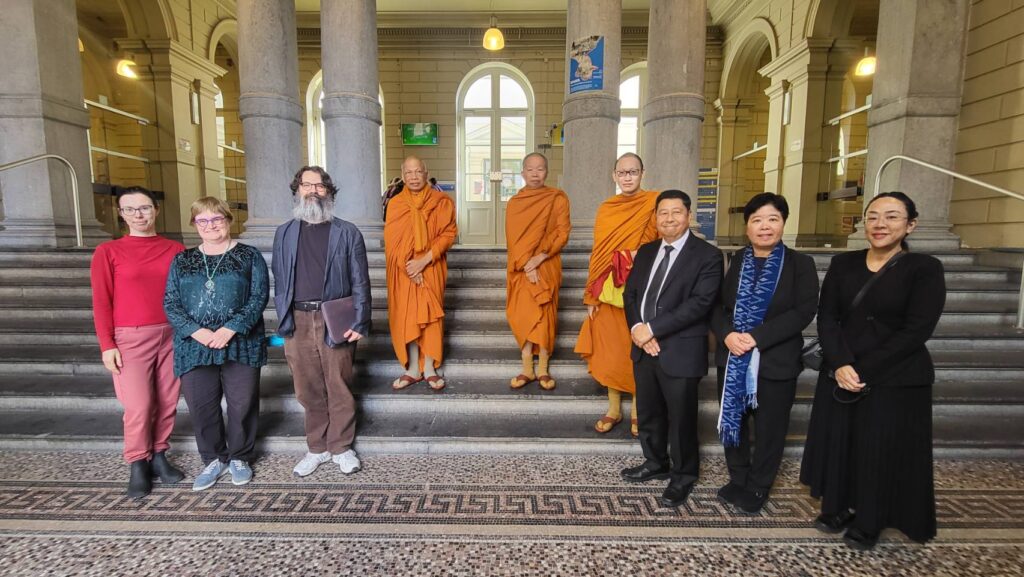
In the first semster of the 2025/2026 acedemic year, GCBS postdoctoral fellow Dr. Paride Stortini, together with Dr. Akshara Ravishankar, is co-organizing the elective MA course “Contemporary Asian Academic Debates I” at Ghent University. Focusing on the theme of “Golden Ages” across different regions of Asia, the course invites students to critically explore how this idea is constructed and contested in various historical and cultural contexts. Several sessions are directly relevant to Buddhist Studies, including Massimiliano Portoghese’s lecture “Xuanzang’s Journey: Tang China and Its Cosmopolitan Golden Age”, which highlights the intersections between Buddhist history, travel, and the making of cultural memory.

Reading group meeting, presentation by Zixuan Wang, September 11, 2025

The Ghent Centre for Buddhist Studies opened its 2025–26 reading group on September 11, 2025, with a focus on rare Vinaya (monastic discipline) texts from Dunhuang. For the first three sessions, the group will engage with primary sources studied by Zixuan Wang, joint PhD student of the Ghent Centre for Buddhist Studies and the Institute of Dunhuang Studies, Lanzhou University. Her doctoral project, “A Study of Buddhist Vinaya Texts from Dunhuang Excluded from the Taishō Tripiṭaka”, examines materials outside the standard Chinese Buddhist canon. The inaugural meeting explored one such text, concentrating on passages concerning the establishment of monastic boundaries (结界).


GCBS members participate in the XXth Congress of the International Association of Buddhist Studies (IABS)

Ghent Centre for Buddhist Studies has a notable presence at the XXth Congress of the International Association of Buddhist Studies (IABS) held at Leipzig University, Germany, from August 10th to 15th, 2025. Our professors, postdocs and PhD students made eight presentations at various panels:

  • Andreeva, Anna (Ghent University): “Buddhist Embryological Knowledge and Women’s Reproductive Health in Medieval Japan: A study of the Daigoji and Kanazawa Bunko manuscripts of Sanshō ruijūshō 産生類聚抄 (Encyclopedia of Childbirth, ca. 1318)”
  • Choi, Jin Kyoung (Ghent University); Matsuda, Kazunobu (BAdW & Bukkyo University): “New Sanskrit Manuscript of the Abhidharmakośa from Afghanistan”
  • Chu, Li-Ya (Department of Languages and Cultures, Ghent University): “Taiwanese Buddhism and Sexual Ethics for Laypeople”
  • DiSimone, Charles (Ghent University): “The Gandhāra Corpora Project: Reports from Year One”
  • Heirman, Ann (Ghent University): “Buddhist Monastics and (Their) Dogs: Daoxuan’s Vinaya Commentaries”
  • Portoghese, Massimiliano (Ghent University): “Debates and Perceptions of Śramaṇas’ Bodily Gestures in Early Medieval Chinese Society”
  • Sokolova, Anna (Ghent University): “The Integration of Buddhist Practices in Tang Dynasty Mortuary Rituals”
  • Stortini, Paride (Ghent University): “Observing Japanese Buddhism from the Peak of the Kailash: Pilgrimage and Mountaineering in the Photography and Travel Accounts of Hasegawa Denjirō”

In addition, GCBS’s Professor Charles DiSimone, together with Naomi Appleton, will chair a discussion on the possibility of holding regional IABS meetings — in particular, an annual European Regional IABS gathering — with the aim of fostering more regular Buddhist Studies research exchange and networking among IABS members in Europe and those able to travel there.

For details, please see the Conference Program.

Virtual Tour of “Sensing the Buddha” Exhibition – Now Online

From 21 September 2024 to 11 May 2025, the Domain & Royal Museum of Mariemont, in cooperation with the Ghent Centre for Buddhist Studies, presented the exhibition Sensing the Buddha — an unprecedented, multisensory immersion into the world of Buddhism.

Although the exhibition has now closed, you can still experience it through the Virtual Tour: 🔗 Start your visit here

For the English version, simply select your language in the upper left corner of the screen. Then switch to full-screen mode, explore the 3D map, move through the space, zoom in on objects, read exhibition panels, and enjoy the embedded audio and video content. You can even try the “dollhouse view” for a unique overview of the exhibition layout.

🎥 Highlights from the virtual experience:

Step inside Sensing the Buddha—no matter where you are—and discover a rich world of history, art, and spiritual insight.